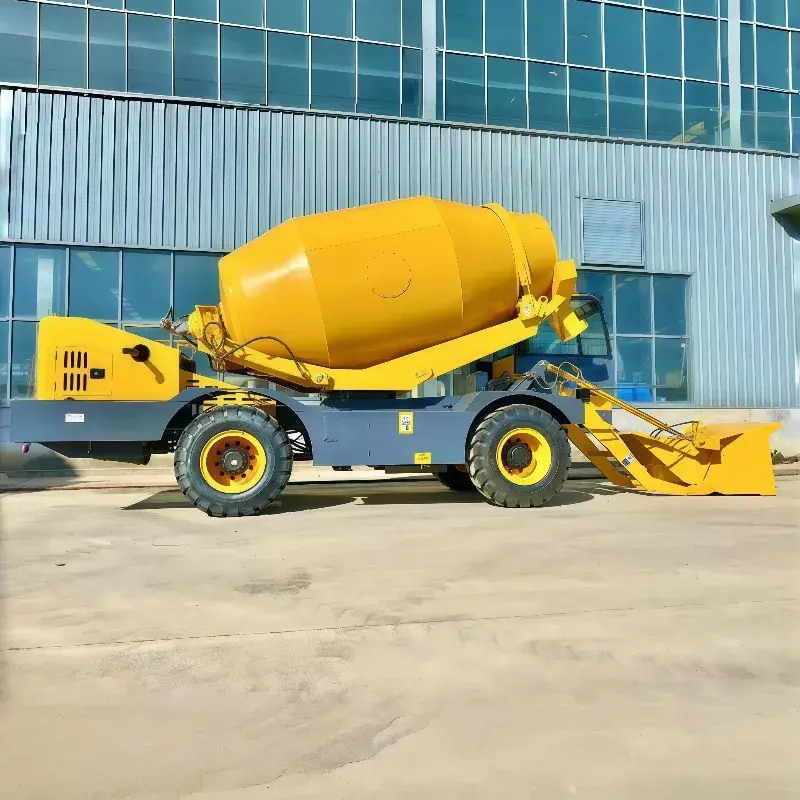
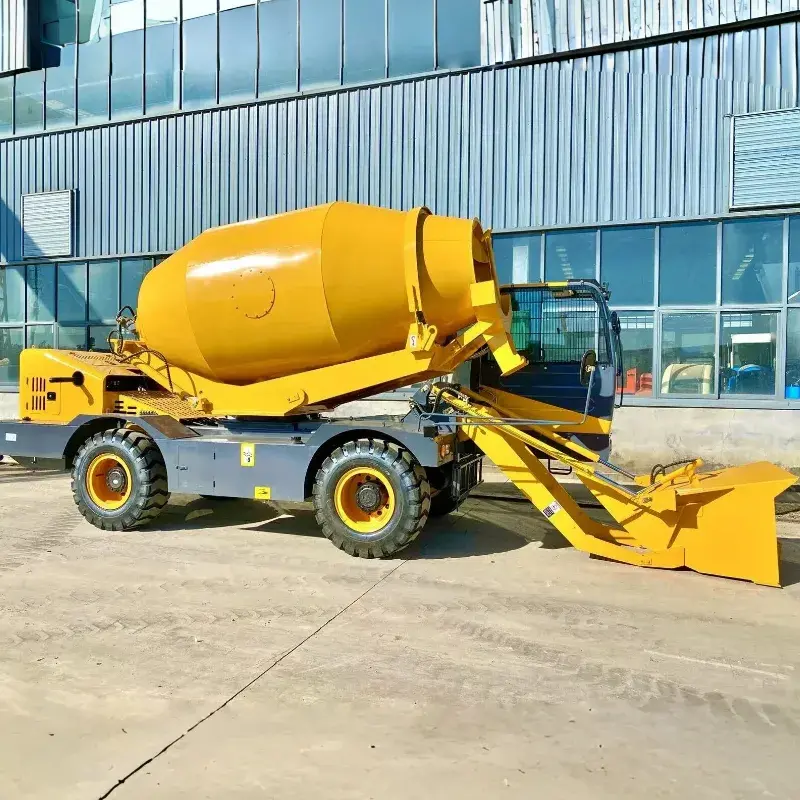
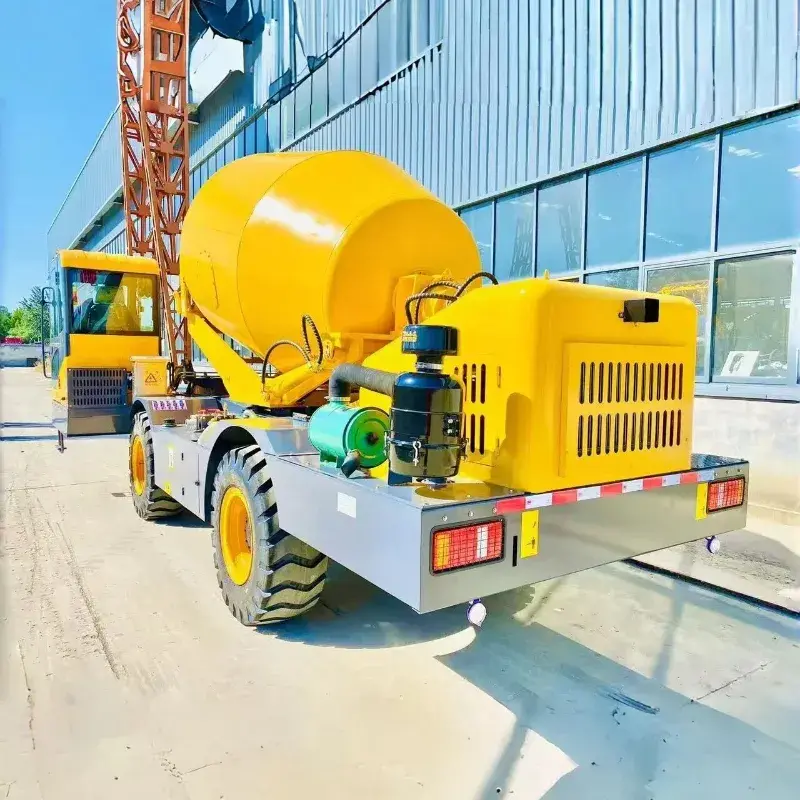
Self Loading Concrete Mixer
Model: SLM1.8,SLM2.6,SLM3.5,SLM4
Feeding Capacity(L):2680-6000
Productivity(m³/h):7.2-16
Diesel Ãngine Power(kW):78-91
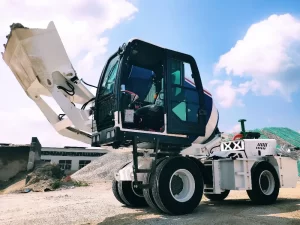
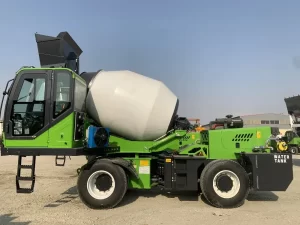
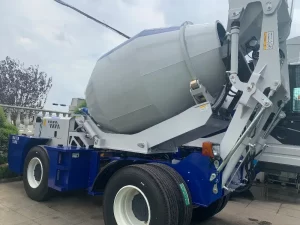
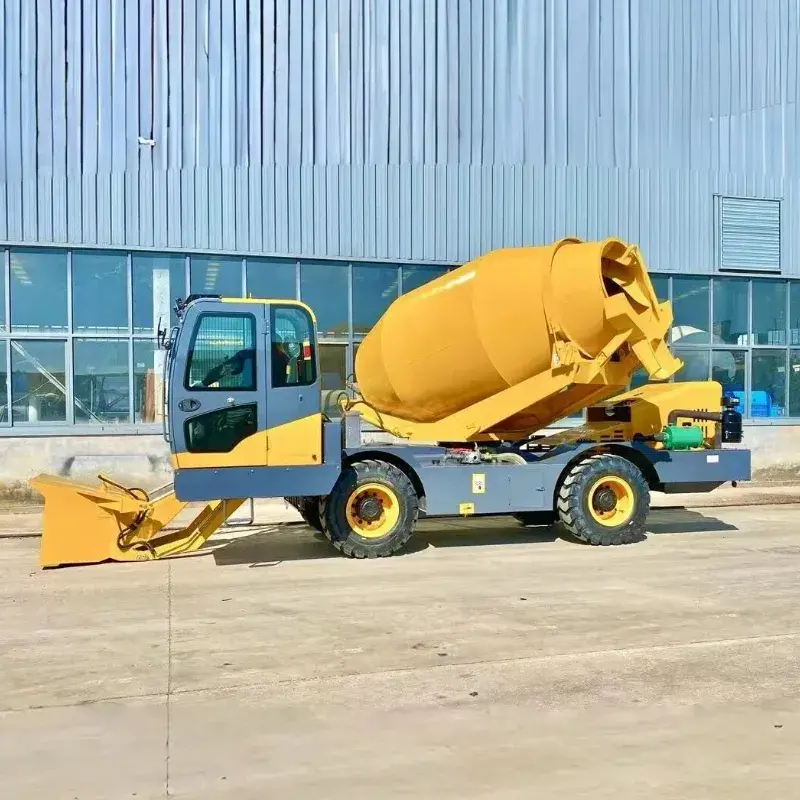
The self-loading concrete mixer trucks integrate multiple functions such as loading, mixing, transportation, and fixed unloading, making them essential mechanical equipment for concrete transportation and mixing. The design primarily focuses on the connection of the rotating body. It allows the vehicle body to flexibly adjust its angle during turns, offering a higher level of control. This provides additional support surfaces for mixing, thereby enhancing mixing intensity.
Introduction
The self-loading concrete mixer trucks integrate multiple functions such as loading, mixing, transportation, and fixed unloading, making them essential mechanical equipment for concrete transportation and mixing. The design primarily focuses on the connection of the rotating body. It allows the vehicle body to flexibly adjust its angle during turns, offering a higher level of control. This provides additional support surfaces for mixing, thereby enhancing mixing intensity.
Main Components of Self Loading Concrete Mixer
Chassis and Articulated Frame
The chassis and articulated frame are the core support of the construction vehicle: the chassis bears the entire vehicle weight and provides a stable platform, with four-wheel drive compatible with different power systems; the articulated frame is divided into front and rear sections, enabling flexible turning, allowing the articulated self-loading mixer truck to maneuver and work with agility.
Drive System
Includes the engine, transmission, drive shaft, differential, etc. Features a reinforced sealing structure that can withstand dust and mud erosion, allowing the articulated self loading transit mixer to maintain stable driving power even under heavy load mixing conditions.
Mixing Conveying System
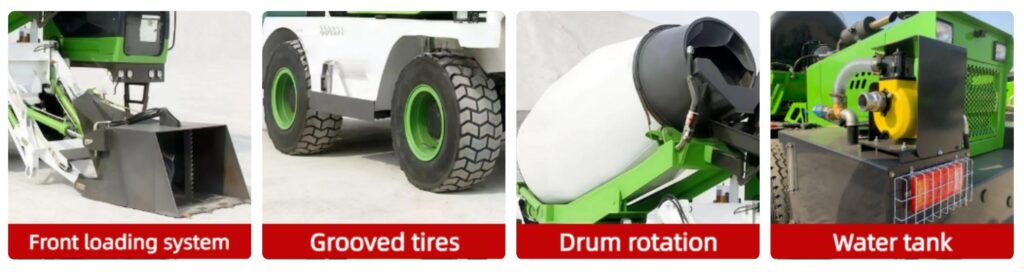
The mixing drum adopts a tilted design with a volume ranging from 1.8 to 4.0 cubic meters. The internal double spiral blades can continuously and uniformly mix the materials while maintaining a stable rotation speed.
Hydraulic Power System
The engine (mostly diesel engine) serves as the core power source to provide energy support. The hydraulic pump and hydraulic motor convert the power into operations such as the rotation of the mixing drum and the lifting of the loading hopper. And the hydraulic oil tank and pipelines are responsible for delivering stable oil pressure to each hydraulic component.
Loading System
The feeding system uses a hydraulic folding hopper and a double hydraulic cylinder lifting mechanism. The loading hopper is equipped with a shovel structure that can directly scoop up sand and gravel. The lifting arm is driven by a hydraulic cylinder to lift the loading hopper and pour the material into the mixing drum.
Water Tank System
The water tank supply system usually consists of a water tank, water pump, pipes, and control valves, which can add water to the mixing drum and control the ratio in conjunction with a water meter.
Driving Control System
The independent cab features a centralized control console, steering wheel, joystick, instruments, and monitoring equipment, enabling integrated operation of vehicle and work functions. It also has a high-definition display screen that can show reverse images and work monitoring images.
Technical Specification
| Model | SLM1.8 | SLM2.6 | SLM3.5 | SLM4 |
|---|---|---|---|---|
| Feeding Capacity(L) | 2,680 | 3,580 | 4,740 | 6,000 |
| Discharging Capacity(m³) | 1.8 | 2.6 | 3.5 | 4 |
| Productivity(m³/h) | 7.2 | 10.4 | 14 | 16 |
| Drum Rotation Angle(°) | 270 | 270 | 270 | 270 |
| Diesel Engine Brand | Yuchai | Yuchai | Yuchai | Yuchai |
| Diesel Engine Power(kW) | 78 | 78 | 85 | 91 |
| Min. Turning Radius(mm) | 5,270 | 5,300 | 5,300 | 4,800 |
| Max. Travelling Speed(km/h) | 30 | 30 | 30 | 35 |
| Grade Ability(°) | 30 | 30 | 30 | 45 |
| Overall Size (mm) | 7,300*2,650*3,750 | 7,860*2,750*4,100 | 7,830*2,680*4,170 | 7,640*2,870*4,750 |
| Total Weight(kg) | 5,900 | 6,500 | 7,500 | 9,000 |
Application
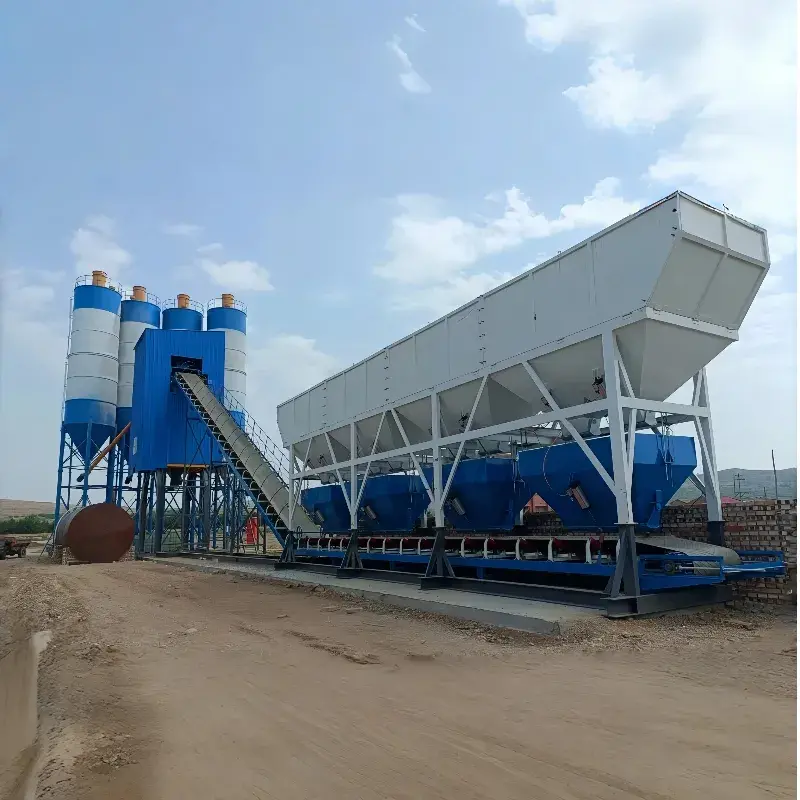
self-loading concrete mixer truck is primarily used to transport ready-mixed concrete from the batching plant to construction sites. Through the continuous rotation of the mixing drum, the concrete is kept in a workable and uniform state during transport, preventing premature setting or segregation. This type of vehicle is widely used in residential, commercial, and infrastructure construction (such as highways and bridges), as well as in both large and small-scale engineering projects.
Main Application Fields
• Residential Projects: Used for pouring foundations, driveways, sidewalks, and other household concrete applications.
• Commercial Buildings: Suitable for large concrete demands, including high-rise structures and parking facilities.
• Infrastructure Construction: Applied in highway, road, bridge, and municipal engineering.
• Small-Scale and Remote Construction: Ideal for municipal maintenance, rural road paving, and projects in complex environments or confined spaces such as mountainous regions and tunnels.